
I was recently tasked with finding a good home for someone’s domain name and Network Solutions was mentioned which made the hairs stand up on the back of my neck.
I recently searched for a few domain names at Network Solutions. Not to buy them — just to check availability and to see if they are still following their deceptive practices. And boy, have they upped their game.
I immediately felt like I needed to wash my hands.
Here is what I saw, verbatim. And to establish standards I ran these searches in a private window to eliminate cookies, history, and telemetry. The result did not change.
[redacted]
is available for $11.99 for the first year!
Act fast — 157 people want a domain like yours!
Out of curiosity, I tried a nonsense string:
jq34js73o9rk2s.com
is available for $11.99 for the first year!
Act fast — 157 people want a domain like yours!
157? Again?
There are not 157 people searching for a random 13-character string.
Let’s try one more:
networksolutions[expletive]agiantbagof[expletive][random number over 1000].com:
is available for $11.99 for the first year!
Act fast — 157 people want a domain like yours!
Same number. Same urgency. Same lie.
There are not 157 people searching for your domain either. That number is not data. It is theater.
Take into account the last one, a domain that is:
-
Profane
-
Absurdly long
-
Clearly non-commercial
-
Statistically searched by exactly zero humans
…still triggers:
“Act fast — 157 people want a domain like yours!”
At this point it is no longer just a dark pattern — it is comically lazy fraud theater.
If this were even remotely grounded in reality:
-
Profanity would suppress interest
-
Length would suppress interest
-
Gibberish would suppress interest
-
The number would change
Instead, the system blindly fires the same urgency banner no matter what you enter. The domain could be:
-
random bytes
-
backwards nonsense
-
or, apparently, a poetic commentary on their business practices
Same result. Same “157”. Every time.
Fake urgency is not marketing — it is manipulation
If this were legitimate demand modeling:
-
The number would vary
-
Nonsense domains would show zero interest
-
Results would fluctuate over time
Instead, the number is fixed. That tells you everything you need to know.
This is a psychological pressure tactic designed to trigger scarcity bias and short-circuit rational decision-making. It exists for one reason: to make users feel they must act now before they have time to think.
That alone would be bad enough. But it gets worse.
The pricing is deliberately hidden until the cart
Network Solutions does not show you the full cost up front. You only see it after the domain is added to your cart — which happens automatically when you search.
At that point, without explicit consent, you now have:
-
A 3-year registration selected by default
-
A renewal price of $28.99 per year
-
“Free” domain privacy that quietly costs $3.99 per month (it is legally required to be offered for free from all registrars)
-
Starter hosting added automatically which “renews” for $11.99 a month
-
A “free” .online domain that renews at $49.99 per year
None of this is visible at the search stage and it is nothing that you want or need if you are just looking to secure your domain name.
By the time a non-technical user reaches checkout, they are already fatigued, confused, and emotionally invested. Removing items feels risky. Continuing feels easier.
This is not transparency. It is conversion by exhaustion.
$28.99 to renew is highway robbery. Reputable registrars charge between $7 and $15 per domain, depending on its value (wmd.dev and wmd.to are premium domains so they cost more).
The $3.99 is an ignorance tax — it is a free service they are marking up 399%.
Starter hosting is unlikely to be used immediately or even “soon” because it takes time to get a website ready to go so they are pocketing that without giving up any resources.
Nobody cares about a .online domain if you already have a .com domain.
The cart ambush is the most unethical part
Searching for a domain should not populate a shopping cart yet as soon as you search you see this (look at the top):
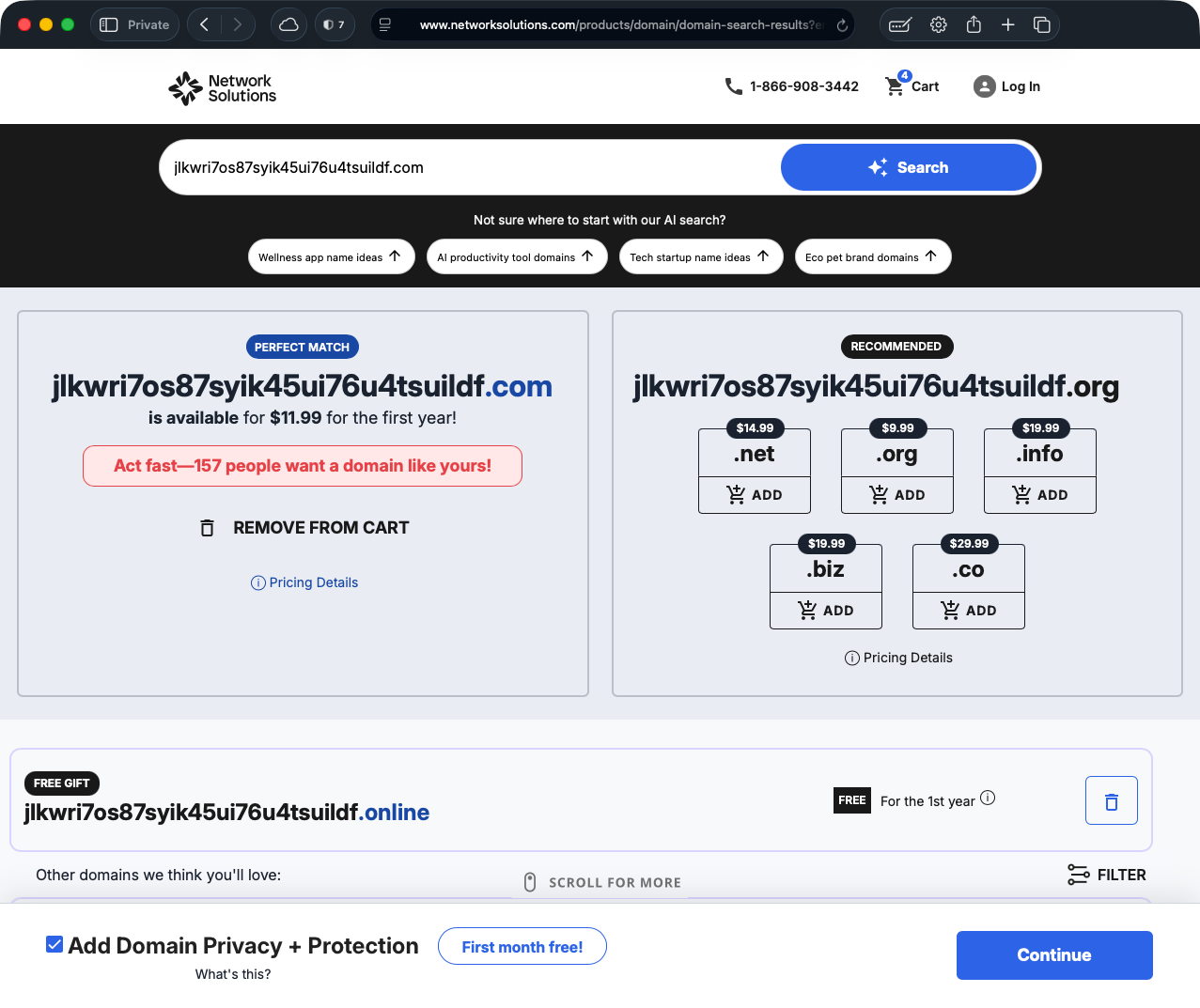
I typed in the domain name and clicked SEARCH. Now there are 4 items in my cart.
That design choice is intentional and predatory. It blurs the line between checking availability and making a purchase. It exploits defaults, inertia, and fear of breaking something.
For nonprofits, advocacy organizations, and volunteer-run groups, this behavior is especially harmful:
-
Budgets depend on predictability
-
Administrative turnover is common
-
Renewal traps compound silently over time
This is how organizations end up wasting hundreds of dollars per year for a single domain without understanding why.
Compare this with reputable registrars
There is a reason professionals recommend Cloudflare Registrar and Porkbun:
-
No fake urgency counters
-
No hidden renewal pricing
-
No auto-bundled junk
-
No cart manipulation
-
No “free” items that become punitive later
You see the price.
You pay the price.
That is the price next year too.
Boring? Maybe. Honest? Absolutely.
Why this still matters
Network Solutions was one of the original domain registrars. They are still riding that legacy while engaging in practices that would not be acceptable in any modern, regulated marketplace.
The fact that they did not even bother randomizing the fake “157 people” number tells you they are not trying to be believable — only effective often enough.
If you manage domains for clients, nonprofits, or anyone who does not live and breathe this stuff, steering them away from registrars like this is not opinionated. It is part of your responsibility.
Feeling “dirty” after using a website is usually a sign that something is wrong.
In this case, your instincts are correct. And FWIW GoDaddy is another awful company that you should avoid.
Featured image by Mediamodifier on Unsplash